
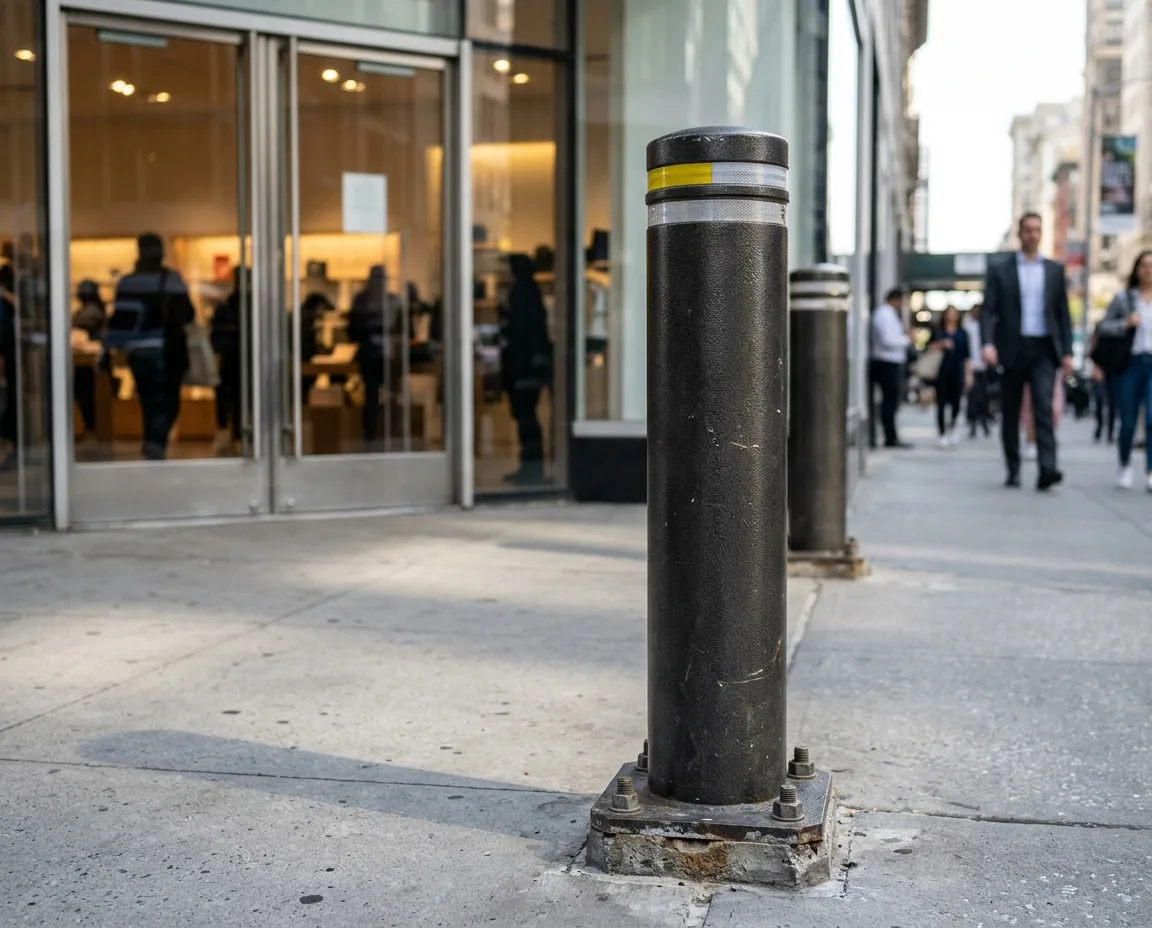
A bollard remains useful as long as its structure, foundation, and protective performance stay fit for the risk it is meant to manage. There is no dependable calendar-year figure for every installation; corrosion, impact history, foundation condition, and operating parts all affect service life.
That matters if you manage storefronts, parking lots, government facilities, or pedestrian areas where a vehicle collision could harm people or property. Security bollard durability is not only about the post’s age. The vehicle threat, site conditions, and role of the barrier shape whether it still provides the intended safety.
This guide helps you assess those factors, compare tested performance, and plan care around real site demands. A post that looks sound may still have hidden damage or a weakened footing. Treat durability as a site-specific safety requirement, not just a choice of steel post.
What Shapes Security Bollard Durability?
A bollard’s durability depends on the whole installation, because the post, foundation, exposure, and use all affect performance. The installed assembly must handle the vehicle threat and the local conditions throughout its working life.

Impact and the tested barrier assembly
A vehicle strike can bend, crack, or dislodge a bollard, even when the post appears sturdy. A collision can also damage connections or transfer force into the foundation and nearby surface.
ASTM F2656 crash-test ratings describe performance against specified vehicle types, speeds, and penetration distances. The rating applies to the tested barrier assembly, not the steel post alone. Its result depends on the post, foundation, connections, spacing, and installation details included in that test.
Impact history matters after installation, too. A barrier that has stopped a vehicle needs assessment before you rely on it again. Visible damage is not the only concern; a shifted footing or stressed connection can reduce strength without a dramatic change above ground.
Exposure to weather and corrosion
Rain, salt, road spray, and standing moisture can wear protective finishes and corrode exposed steel. Coastal air and winter de-icing compounds add chloride exposure, which can speed corrosion on surfaces and at joints.
Corrosion can thin metal or weaken a connection over time. Look closely at seams, fasteners, base plates, and places where water collects. A coating can hide early damage, so appearance alone does not confirm that the barrier remains sound.
Foundation condition also responds to site exposure. Water, poor drainage, soil movement, and repeated freeze-thaw conditions can affect the concrete or surrounding surface. A stable-looking post may move if its footing or supporting soil has changed.
Use cycles and serviceable parts
Fixed bollards have no moving parts, so their maintenance is usually cosmetic work such as repainting, cleaning, or replacing a damaged decorative cover. Their protective role still depends on sound structure and foundation.
Retractable bollards add locks, guides, motors, gears, hydraulic parts, or sensors that can wear through repeated operation. The use pattern matters: a busy vehicle entrance puts more demand on those parts than a barrier that moves only occasionally.
When comparing security bollards, consider both the post and the mechanism that controls it. Ask which parts need service, what operation the site expects, and how damage will be identified. Do not treat a thick steel post as proof that the installed barrier will perform as intended.
How Long Do Different Bollards Last?
Cycle ratings give the clearest comparison for retractable bollards, ranging from thousands of events for manual systems to hundreds of thousands for automatic systems. A cycle means one lift-and-lower event, not a promise of a set number of calendar years.
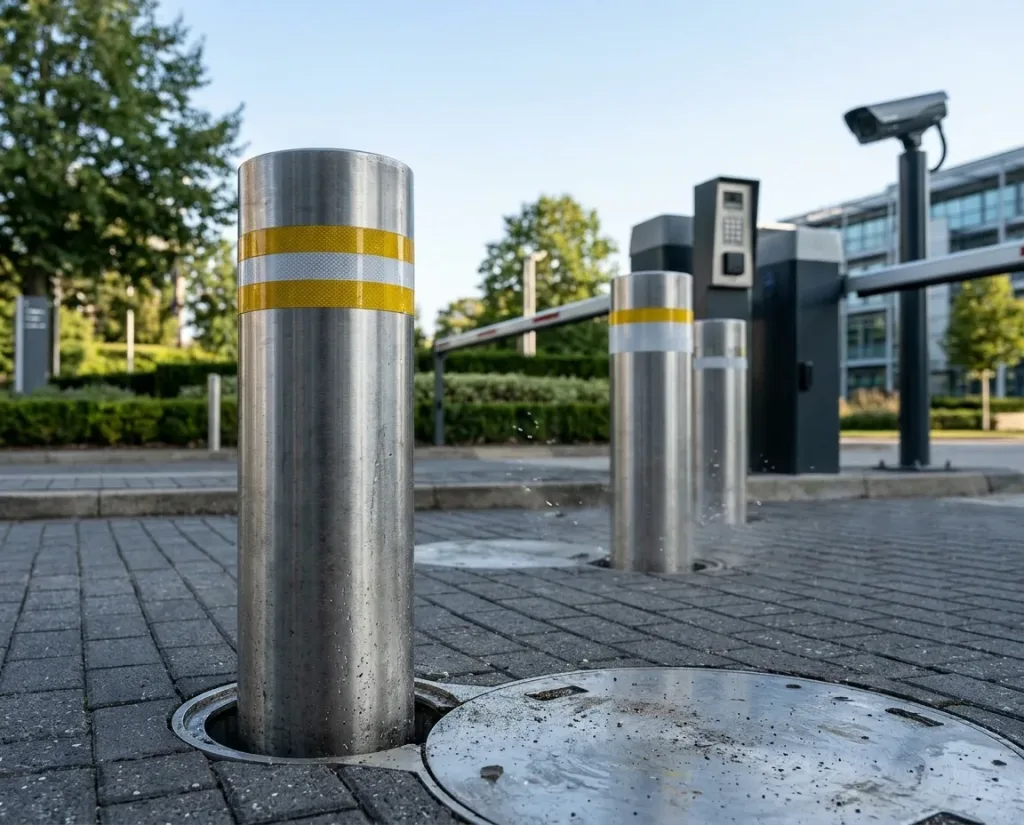
Cycle ratings help you compare operating mechanisms, but they do not predict every service life. Actual years of use depend on how often the bollard moves, maintenance, site exposure, and the condition of its installation.
Manual telescopic models need a person to raise and lower each post. Manual telescopic crash-rated retractable bollards also require hands-on operation, while their tested protective role adds design demands. A high cycle rating does not replace the manufacturer’s care requirements or confirm that a particular site suits the system.
Automatic retractable bollards usually carry higher typical cycle ratings than manual telescopic models. Electromechanical systems use a motor and gear or screw arrangement; hydraulic systems use fluid pressure to raise and lower the post. Their ratings assume the maintenance qualifications shown by the manufacturer.
| System | Cycle rating | Qualification |
|---|---|---|
| Manual telescopic | 5,000-20,000 events | Before service |
| Manual telescopic crash-rated | 3,000-10,000 events | Before service |
| Electromechanical automatic | 100,000+ events | Manufacturer-specified maintenance |
| Hydraulic automatic | 200,000+ events | Annual hydraulic-fluid service |
The figures describe expected operating events, not guaranteed performance at every site. High use may bring a system to its rated cycles sooner in calendar time, while infrequent use does not prevent corrosion or damage from neglect.
For automatic retractable bollards, compare the stated rating with daily access needs and the service capacity available on site. Ask whether the rating applies to the full system and what conditions the manufacturer assumes. Compare the manufacturer’s stated cycle rating with the number of access operations the site expects.
What Do ASTM Crash Ratings Actually Measure?
An ASTM crash rating identifies the test vehicle and speed, then reports how far the vehicle penetrated beyond the barrier. Penetration is the distance the test vehicle travels beyond the barrier after impact.
The rating helps you assess a tested barrier against a defined threat. It does not describe every vehicle, installation, or impact, and it does not assign a rating to a steel post in isolation.
ASTM F2656 ratings and penetration
ASTM F2656 identifies the test vehicle and its speed, then uses a penetration class to report the stopping result. For example, an M30/P1 rating means the tested barrier stopped a 15,000-pound vehicle traveling at 30 miles per hour with penetration of 3.3 feet or less.
Under ASTM F2656, P1 means penetration of 3.3 feet (1 meter) or less. P2 means more than 3.3 feet (1 meter) and up to 23 feet (7 meters). P3 means more than 23 feet (7 meters) and up to 98.4 feet (30 meters).
The letter and number in a crash rating answer different questions. The vehicle class and speed describe the test challenge; the penetration class describes the distance traveled beyond the barrier. A shorter penetration result may suit a site where space behind the barrier is limited.
Crash-rated bollards are tested as part of a specific configuration. The test result applies to that arrangement, including its spacing, foundation, and installation details. Changing those elements can make the installed barrier different from the one tested.
ASTM F3016 ratings for lower-speed impacts
ASTM F3016 uses a 5,000-pound surrogate vehicle at 10, 20, or 30 miles per hour. Its penetration thresholds differ from F2656, so you should not treat the two standards’ P classes as interchangeable.
Under F3016, P1 means penetration of 1 foot (0.3 meter) or less. P2 means more than 1 foot (0.3 meter) and up to 4 feet (1.22 meters). Penetration beyond 4 feet (1.22 meters) counts as a failure.
Use the test details to judge whether a rating fits the likely vehicle and approach speed at your site. A lower-speed test may address a different risk than a test involving a heavier vehicle at higher speed. Match the tested rating to the site’s threat and required stopping distance, rather than choosing by the word “crash-rated” alone.
Which Materials Resist Weather and Corrosion?
The right material depends on what the bollard will face, especially chloride exposure from coastal air or winter de-icing. Local exposure should guide your choice of steel, finish, and protection at joints.
Grade 304 stainless steel generally suits inland sites with low chloride exposure. It contains 18-20% chromium and 8-10.5% nickel. Grade 316 contains 16-18% chromium, 10-14% nickel, and 2-3% molybdenum; that molybdenum contributes to higher resistance during sustained chloride exposure.
The visible surface does not always show the structural material. Many stainless bollards use a carbon steel structural core covered by a stainless sleeve. The sleeve’s top and base need effective seals, since moisture that reaches the core can cause corrosion beneath the finish.
| Material | How corrosion protection works | Site or upkeep consideration |
|---|---|---|
| Grade 304 stainless steel | Chromium-rich alloy surface | Inland sites, low chloride exposure |
| Grade 316 stainless steel | Molybdenum adds chloride resistance | Coastal air or de-icing exposure |
| Powder-coated carbon steel | Coating shields the steel | Damage through coating exposes steel |
| Corten steel | Protective oxide forms through wet-dry cycles | Oxide runoff can stain adjacent paving |
A powder-coated steel bollard relies on an intact coating. Scratches, chips, or impact damage that break through the finish expose the carbon steel below. Check the finish near the base and at points where equipment, vehicles, or tools may strike it.
Corten steel develops a protective oxide through alternating wet and dry conditions. The runoff can leave stains on nearby concrete or stone, so the look of the surface should not be the only factor in a project specification.
Stainless steel can still show surface staining if site conditions overwhelm its protection or contaminants remain on it. A material choice should account for chloride exposure, adjacent finishes, and the full construction of the steel bollards. Specify the structural assembly and its sealing details, not just the finish visible above ground.
How Often Should Retractable Bollards Be Serviced?
Service retractable bollards on the mechanism’s schedule, and clean exposed surfaces often enough to remove the contaminants their site collects. Scheduled care helps you catch wear before a fault interrupts access control.
Manual telescopic mechanisms
Manual telescopic retractable bollards typically need lock-mechanism service every 12 to 18 months. The full mechanism also needs service at the manufacturer-specified cycle interval.
Check that the post moves and locks as designed, and report any binding or looseness. A manual mechanism can become unreliable even when it sees little use, especially if its lock or guide has been damaged.
Hydraulic automatic mechanisms
Hydraulic retractable bollards typically need annual hydraulic-fluid checks and seal inspection. Schedule pump service at the manufacturer-specified interval, since a pump fault can affect the whole lane.
Watch for changes in operating speed or movement that feels uneven. A change in cycle behavior can signal a problem that deserves inspection rather than repeated attempts to operate the system.
Electromechanical automatic mechanisms
Electromechanical retractable bollards typically need an annual motor and gear inspection, plus screw or rack lubrication. Follow the equipment maker’s instructions for lubricant type and service access.
Use a consistent checklist so staff can compare conditions between visits:
- Inspect moving parts for wear, binding, or visible damage.
- Confirm that each bollard completes its expected operation.
- Look for loose, bent, or damaged components and connections.
- Record the date, findings, repairs, and next service due.
Stainless bollards may need quarterly cleaning at inland sites, every 4-6 weeks in high-traffic urban locations, and monthly fresh-water rinsing at coastal or de-iced sites. Treat these intervals as starting points, then adjust for actual contamination and manufacturer guidance.
Cleaning removes salt, grime, and other deposits before they remain on the surface. Site staff should note where soil, traffic spray, or de-icing residue collects, since those patterns can make one area need more attention than another.
Keep dated service records so a recurring fault or missed maintenance interval is visible before it disables access control.
How Does Installation Affect Service Life?
A bollard’s foundation must follow the design for that specific barrier, not a depth chosen by appearance or convenience. Installation details help preserve both durability and the tested performance of the assembly.
Match the foundation to the tested design
The manufacturer’s drawings control foundation depth and width, concrete strength, reinforcement, soil bearing capacity, connections, and installation tolerances. Those specifications work together; changing one can alter how a barrier carries impact forces.
Security bollard concrete foundations are classified as shallow at 24 inches deep or less, and deep at more than 24 inches. A standard K4-equivalent bollard footing often extends 36 to 48 inches below grade, but the project drawings control the actual design.
Surface-mounted or shallow systems can suit constrained sites, but they still need details that match their tested design. A shorter footing is not an acceptable substitute for a specified assembly simply because excavation is difficult.
Protect and drain the bollard pit
A retractable bollard’s ground-level housing is called a bollard pit. The housing typically extends 36 to 60 inches below grade, depending on rating tier, and includes drainage provisions.
Drainage needs to suit local soil and site conditions. The pit should not be treated as a simple sleeve in the pavement; water management and the housing design affect the mechanism’s long-term condition.
Before concrete placement and final acceptance, confirm these installation points against the drawings:
- Soil bearing capacity matches the specified design.
- Concrete strength and footing dimensions meet the drawings.
- Reinforcement sits in the specified location and arrangement.
- Connections and installation tolerances match the tested configuration.
- Drainage provisions are present and functioning as designed.
Small field changes can add up. A misplaced connection, altered reinforcement, or uneven installation may leave the post out of alignment or change how the footing responds to force. Record approved changes rather than relying on verbal direction alone.
Have the installer verify the completed footing and connections against the manufacturer’s drawings before putting the lane into service.
Which Bollard Type Fits Each Site?
Choose the bollard type by deciding first whether the site needs permanent protection or periodic vehicle access. Access needs determine whether a fixed post, a removable unit, or a retractable system fits the entrance.
Common types include fixed, removable, retractable, and flexible designs. Safety bollards protect people and property only when their protective capacity matches the threat they must address.
Fixed bollards for permanent protection
Fixed bollards suit a permanently restricted edge, such as a sidewalk beside a storefront or a pedestrian route along a parking lot. They can form a bollard barrier that limits vehicle movement while leaving room for people to pass.
A storefront may need protection from vehicles that could cross the curb, while a parking-lot edge may need a clear pedestrian boundary. In either area, spacing and placement should protect the path without blocking accessible movement or routine site use.
Flexible bollards can guide traffic or mark an edge, but they are not a substitute for a tested vehicle barrier. Their purpose is to shape driver behavior, not to provide the same impact protection as a crash-tested system.
Removable and retractable bollards for controlled access
Removable bollards suit an entrance that needs occasional vehicle access but does not require a permanently open lane. Retractable security bollards manage controlled vehicle access at sites where staff need to open and secure an entry.
Retractable bollards can be manually or mechanically operated, including automatic hydraulic or electromechanical systems. Retractable bollards for a driveway suit driveways that must alternate between open access for authorized vehicles and a restricted state.
Choose a system that aligns with how often vehicles enter, who controls access, and how quickly the lane must change state. A fixed post may be simpler where access never changes; a movable design adds operating parts and procedures.
Consider the approach path for vehicles as well as the space reserved for pedestrians. Confirm that the selected type leaves the required pedestrian route and authorized vehicle path usable.
How Do Water and Freezing Conditions Cause Failures?
A flooded or frozen bollard pit can turn an access-control problem into a lane that no longer operates. Water intrusion can affect the post, controls, and operating parts before a fault becomes obvious.
Water in the pit can corrode an automatic retractable bollard body and contaminate hydraulic fluid. It can also damage sensors, leading to mechanical faults, slower cycles, or a lane that stops operating.
Cold adds another risk when water or unsuitable fluid affects a hydraulic system. In freezing climates, hydraulic retractable bollard specifications should include pit heaters and hydraulic fluid rated for the site’s temperature range.
These faults can disrupt vehicle access at government facilities, commercial properties, or other areas where security and safety depend on a working lane. A slow cycle may signal water or sensor trouble, even if the bollard still moves.
Use a clear response when staff notice water or a change in operation:
- Inspect the drainage provisions for visible blockage or damage.
- Check the pit for standing water and note its location.
- Record sensor faults, slower cycles, or other operating changes.
- Isolate a nonoperating lane safely and prevent unsafe vehicle access.
- Call the qualified service provider to inspect the system.
Do not keep cycling a malfunctioning post in an attempt to clear the problem. A repeated fault can leave vehicle access unpredictable and may worsen damage to operating parts.
Record when the fault began, what staff observed, and whether the lane remained open or closed. Those details help the technician assess the issue without relying on memory after the site has changed.
Treat slow cycles or sensor faults as service issues to investigate promptly, not as harmless changes in normal operation.
Build Durability Into the Site Plan
A durable installation starts with a written match between the site’s risk, access needs, and maintenance capacity. Document the vehicle threat, expected access pattern, exposure to weather and road chemicals, and who will inspect the equipment.
Use those conditions to select the complete tested assembly and its service plan, not a post based on appearance alone. Before approving a purchase, have the project team confirm the tested assembly, foundation drawings, drainage, and maintenance owner.